David’s Desk: The Messy Middle
Nothing great is ever built in a straight line.
The businesses that get where they want to go aren't the ones that avoid hard decisions. They're the ones that push through them. The uncomfortable pivots, the feedback that stings, and the moments where it isn't clear if things will come together.
These moments aren't obstacles. They are the process.
Scaler exists today because of every pitch that fell flat, every client we lost, and every piece of work we had to redo. I used to want to skip past those moments. Now I understand they were the whole point.
Most companies stay average because they accept average. They pull back at the first sign of friction, avoid the decisions that feel risky, and wonder why nothing ever changes.
Fear of failure truly is the number one cause of failure.
The discomfort isn't a sign that something's wrong. It's usually a sign that something's about to get a lot better.
In this month's Scaler Spark, we're looking at what it actually takes to trust the process, in design, in business, and in growth.
Science of Insight: Lessons from Airbnb

In October 2007, roommates Brian Chesky and Joe Gebbia couldn't afford their rent in San Francisco. When a major design conference came to town and hotels completely sold out, they saw a desperate opportunity: they bought three air mattresses, set up a simple blog offering a place to sleep and homemade breakfast, and hosted three strangers on their floor for $80 a night.
That scrappy experiment gave birth to Airbnb. But the path from air mattresses to a global business wasn't immediate.
By 2008, they were still so broke they had to sell novelty cereal boxes just to keep the company afloat. Investors thought the idea was absurd. Who would actually want to stay in a stranger's house?
But instead of pivoting away from the discomfort, they went deeper into it. They flew to New York, stayed with their own hosts, photographed the apartments themselves, and figured out what wasn't working one listing at a time.
That's not a startup fairy tale. That's what trusting the process actually looks like: not blind optimism, but staying in it long enough to figure it out.
Airbnb is now valued at over $75 billion. Not because the initial idea was perfect, but because the founders refused to accept failure when things got hard.
Guest Voice: Ashley Faus, Head of Lifecycle Marketing at Atlassian

Ashley Faus leads lifecycle marketing at Atlassian, one of the most recognized names in team productivity software. She's also the author of Human-Centered Marketing: How to Connect with Audiences in the Age of AI, a speaker at INBOUND and Harvard Business Review, and a Stanford instructor. She knows a thing or two about what it means to stay in the process when it isn't working.
We asked her how she does it.
Her first time live streaming at events was rough: unreliable connections, no strategy, minimal engagement. But she stayed with it. "That taught me the value of having people who can speak off-the-cuff, helped me hone my ability to find the hook in the moment, and the value of real-time feedback." It didn't feel like progress at the time, but it was.
Her framework for knowing when to push and when to pivot? "I think it depends on what's not working. Is it a tight timeline but you're still making progress? Push through. Is it that the audience isn't responding at all? Try changing a single element to see if it's just an algorithm issue or if the content truly doesn't resonate." Not all friction means stop. Many times it just means you're getting closer.
And when things aren't clicking? She steps away. "I get the best ideas when I'm away from the computer and enjoying the sunshine. Sometimes it's best to step away from the problem, and a walk means there's more external inputs hitting my brain to help make connections in the background."
Trusting the process, Ashley would tell you, also means protecting it. "If we're going to make room for greatness, that means sometimes we have to say no to goodness."
The messy stages aren't detours. They're exactly where the best work gets built.
Team Feature: Diego, Creative Director

Every designer knows the moment. You've put real thought into something, the concept, the execution, the details, and the client comes back with: it's not quite right.
It's the creative equivalent of going back to zero. And how you handle that moment is what separates good work from great work.
At Scaler, Diego Toda de Oliveira lives in that tension. As our Creative Director, his job isn't just to design, it's to keep moving when the direction isn't landing, find a new angle when the first one doesn't click, and bring the same energy to every round of revision that he brought to round one.
"One of the biggest misconceptions about the creative process is that following the right steps guarantees a smooth outcome. It doesn't. Planning, wireframing, and design all exist to reduce uncertainty, but even the best process can't eliminate it completely."
Instead of fighting the uncertainty, Diego structures his workflow so the client is a collaborator in the messy middle, rather than just an approver at the end.
"I've learned that trusting the process isn't about believing every idea will work the first time. It's about building a process that makes it safe to discover what doesn't. The projects that succeed aren't the ones without friction, they're the ones where communication stays open, feedback happens early, and everyone is solving the same problem together."
When both sides commit to navigating that uncertainty together, the result is always stronger than anything we could have built alone.
Client Spotlight: Helix Biostructures
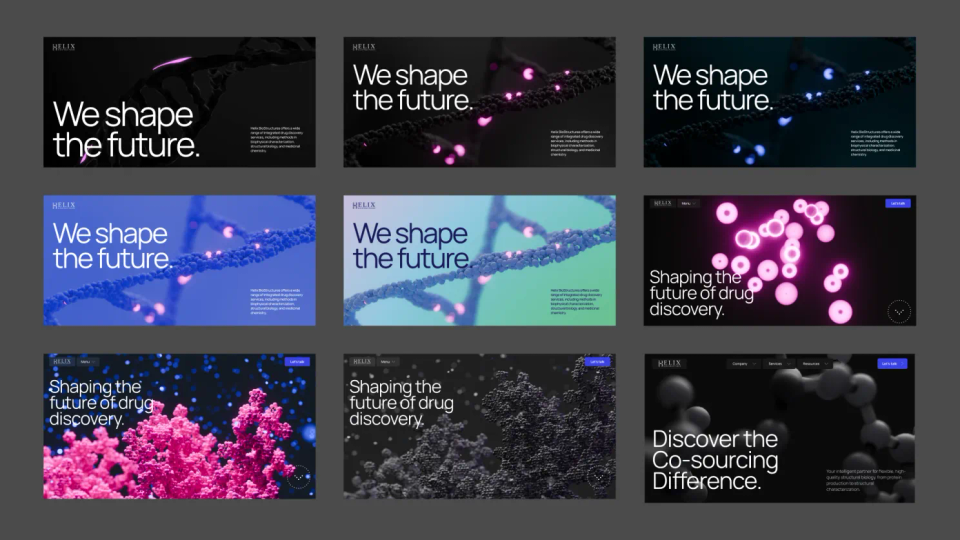
Helix Biostructures is a gene-to-structure CRO combining cutting-edge technology with deep structural biology expertise to power their clients' research and discovery.
They came to us knowing exactly what they wanted: a website with a wow factor that matched the caliber of their work. What they didn't know yet was how many versions it would take to get there.
The first round had a bold pink color direction, helix motifs front and center, and a lot of early energy. The client pushed back. The pink wasn't right. Some of the helix treatments felt too literal. They wanted something more dynamic, more alive. So we scrapped it and kept going.
That's not a failure story. That's the process working exactly as it should. Instead of disappearing for weeks and returning with three polished concepts, we iterated in the open, mood boards before mockups, wireframes before anything was locked, real feedback before anything was finished. Every round got sharper because the client was part of building it, not just approving it.
What came out the other side was something none of us would have arrived at alone, and the work only got there because nobody tried to skip the messy middle.
“Scaler did an absolutely amazing job with our one-of-a-kind website. The entire journey, from mapping out the site and ideas to the final site was a wonderful experience.” — Joshua Carter, Owner/CEO, Helix Biostructures
We break down more about this iterative process in our blog → The myth of the big reveal, why iterative design wins
The Move:
The number one cause of failure isn't a lack of knowing what to do. It's fear.
Most companies aren't confused about what needs to happen. Deep down, they know. What stops them is fear: fear of judgment, fear of losing their job, fear of getting in trouble, fear of looking foolish. That fear is what keeps companies average. It's what turns bold moves into safe ones and real change into edge-tweaking.
So the move is simple, but not easy: get honest with yourself about what you're afraid of.
This week, write down the things that are holding you back. Write down what you know, deep down, you should be doing, but haven't, because you're afraid. Do this as an individual. Do it as a company.
Then just do them.
If you're not sure what that looks like, let's figure it out together. Book a call with David here.