
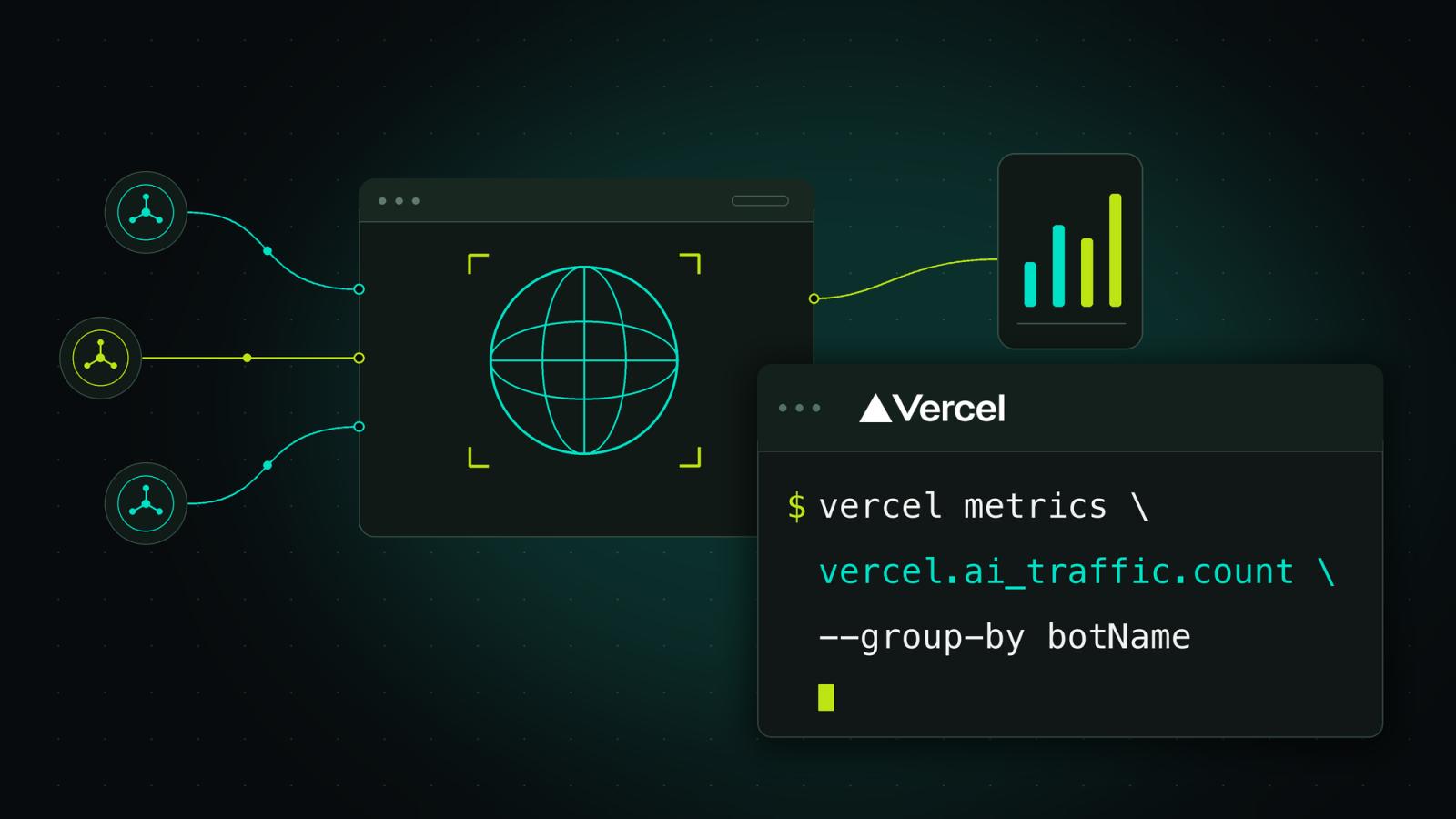
Vercel's AI Traffic insights show which AI bots request your pages, which pages they ask for, and where they run into errors. That tells you whether AI assistants can reach the content buyers need. It does not tell you whether your brand appeared in an answer or whether anyone became a customer.
The feature was announced on October 27, 2026, and it only covers websites hosted on Vercel. For a marketing team, it is a practical starting point, if a potential buyer asks an AI assistant about the kind of product or service you offer, can it find useful information on your website?
What Vercel AI Traffic insights actually do
AI Traffic is a reporting view within Vercel Observability, its website monitoring tools. It records requests arriving at your site from recognized AI bots. It does not send a new Vercel crawler out to audit your pages.
According to Vercel's documentation, the view separates crawlers that index content or collect training material from assistants fetching pages in response to a user. It also shows frequently requested pages, failed requests and requests for Markdown, a plain-text format with simple formatting.
A training crawler may be gathering material for future AI models, while an assistant might open your product page to help someone compare suppliers. Both generate requests to your website, but those requests don’t tell you how many people visited it.
Why different AI bots need different decisions
You don't have to make one blanket decision about every AI system visiting your website.
OpenAI documents separate controls for GPTBot, which collects material that may be used for model training, and OAI-SearchBot, which helps surface websites in ChatGPT search. Site owners can allow the search crawler while disallowing the training crawler. ChatGPT-User supports certain user-initiated visits and has a different role again.
Anthropic makes a similar distinction between ClaudeBot, Claude-SearchBot and Claude-User.
Perplexity's documentation also separates search crawling from user-requested page visits.
For a business publishing technical expertise, that creates a useful discussion. Which public pages should be available to search assistants? What is your policy on training use? Are your website settings consistent with those choices?
Your development team can review the relevant crawler instructions and firewall rules. Avoid treating a bot's name alone as proof of identity. Vercel's bot management documentation explains how legitimate bots can be verified using signals such as published IP ranges and cryptographic signatures.
Start with the questions your buyers need answered
Looking at the busiest URLs is useful, but it helps to begin with the pages your business actually needs people to find.
Imagine you sell laboratory instruments. Someone comparing suppliers might need to know whether your equipment supports a particular workflow, which samples it handles and what evidence backs its performance. If the relevant information is scattered across an old announcement and an image-only brochure, a successful request to your homepage tells you very little.
Choose a small set of important pages before opening the report. These could include your main product or service pages and the technical guidance buyers use when evaluating a supplier.
Then ask whether those pages answer the questions clearly. Are specifications available as text? Are limitations explained? Can a reader find supporting evidence and a sensible next step?
This is where information architecture and search authority connect. Clear page relationships and useful internal links help visitors move from a broad question to the detailed information they need.
How to review AI traffic without over-reading it
For a Vercel-hosted project, open Observability → AI Traffic in the dashboard. A first review can follow these steps:
Compare crawlers and assistant fetches.
Look at which bots are requesting content and what their documented purpose is. Keep training activity separate from search and user-directed retrieval.
Check the pages you selected.
Are bots requesting them? Which URLs are assistants fetching? An absence of requests during a short reporting window is a reason to investigate, rather than proof that a page is blocked.
Investigate errors with your developer.
A missing page, access restriction or server error calls for a different response. Some restrictions may be intentional. Check the cause before changing a rule.
Check the content that was returned.
A successful HTTP response means the request succeeded. Have your developer confirm that the response contains the important information, rather than an empty shell or a login screen.
Record changes and review again.
If you repair a broken URL or an unintended access rule, note the date and look for subsequent successful requests. Use a consistent reporting window when comparing results.
Vercel offers Observability across its plans with limits. Check the available history and features in your account before deciding how much data you need. The launch announcement specifies that querying the new metrics through the command line requires Observability Plus.
Connect access data to business results
Crawler reporting helps diagnose access. To judge marketing value, you need to look further along the buyer's journey.
Keep four questions separate:
- Can the AI system retrieve the page?
- Does your business appear accurately in relevant AI answers?
- Do people visit your website from those answers?
- Do those visits contribute to useful inquiries or sales?
Each needs its own evidence. Request logs address the first question. Reviewing actual answers can help with the second, although results vary by prompt, platform and time. Website analytics and your inquiry or CRM records help with the remaining questions, within the limits of attribution.
Scaler's article The Smallest Slice, The Biggest Signal explores why the behavior of AI-referred visitors deserves attention alongside traffic volume. The new Vercel view adds a way to investigate access before a visitor arrives.
A rising bot count alone should not become a success metric. It may reflect repeated crawling of the same pages. Look for changes that help buyers get accurate information and take the next step.
Should you change your website or hosting for this?
For a website already hosted on Vercel, the feature is worth exploring as part of an existing technical and search review. Moving a website solely to gain this dashboard would need a much stronger business case.
At Scaler, we build and host Webflow websites on Webflow. For some projects, we use a separate stack hosted on Vercel with Sanity for content management. This Vercel reporting applies to the latter setup. A Webflow-hosted website needs monitoring suited to its own platform and configuration.
Whichever setup you use, keep working on the fundamentals. Google's current guidance on generative AI search continues to emphasize useful, original content and sound technical SEO. Those principles remain valuable beyond a single dashboard.
Be deliberate about what you expose. Public product information may support discovery; confidential research and client material need proper access controls. As Google explains, robots.txt instructions are not a way to secure private information.
If you're unsure where to begin, choose one important buyer question and the page that should answer it. Check whether that page is accessible, accurate and helpful, then work outward from there. Scaler's SEO and AEO services bring technical website work and content strategy together to support that process.