

For the past few years, the online marketing world has been in a state of perpetual panic. The narrative is: AI search engines are going to completely kill website traffic, traditional search is dead, and every growth leader needs a radical new AI strategy before they become obsolete.
Panic is a terrible strategy.
As Chief Growth Officer, my job isn’t to chase headlines or make wild predictions about the future of tech. My job is to look at the data. While the industry spends its time debating the theoretical demise of the desktop click, we have been quietly building infrastructure to measure what is actually happening.
The reality is far more interesting than the hype, and it points to a massive opportunity for brands that value revenue over vanity metrics.
The Hard Data: Low Volume, High Value
We are currently tracking AI-referred traffic in GA4 across our entire client portfolio, spanning multiple industries, B2B and B2C, and giving us a clear, aggregate look at how consumers are actually transitioning from AI tools to live websites.
The data reveals two undeniable truths.
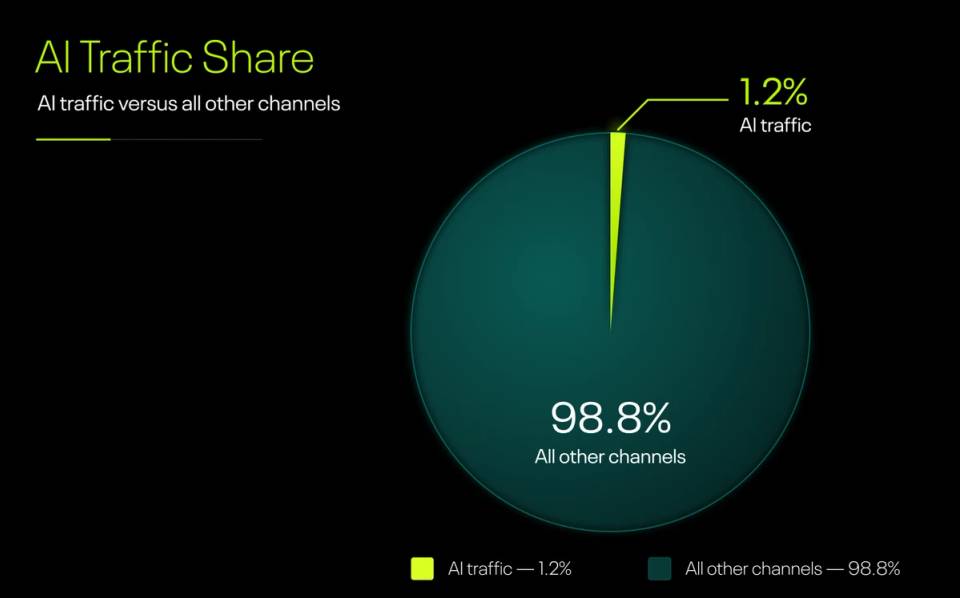
First, the volume is tiny. If you look at your overall traffic pie, AI search tools represent just a tiny slice of the overall traffic pie for most businesses. The hype-to-traffic ratio is wildly disproportionate. If you are expecting ChatGPT or Perplexity to replace your organic search traffic this quarter, you are looking at the wrong timeline.
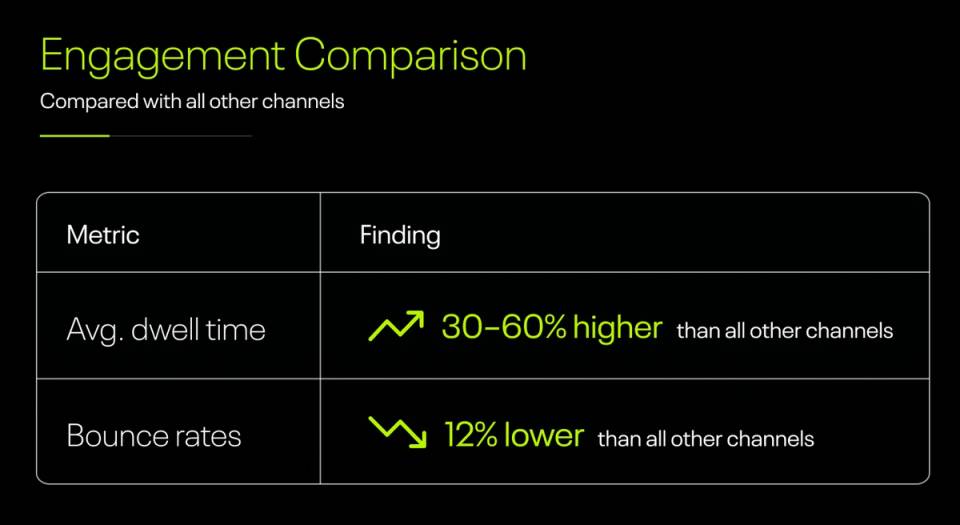
Second, the traffic that does arrive from AI is pure gold.
When we look at the behavior of these visitors, the metrics are staggering. Across our client portfolio, the average dwell time for AI-referred visitors is significantly higher than that of standard organic or paid traffic. Concurrently, the bounce rate is significantly lower.
Think about what that means. These users aren’t clicking a link by accident and hitting the back button. They are landing on the site, staying, reading, and engaging.
Why is this happening? Because AI tools act as the ultimate high-intent filtering mechanism. By the time a user prompts an AI, reads the synthesized response, and clicks on a tiny citation link, the heavy lifting of sorting and vetting has already been done. The user arriving at your website isn’t a casual browser. They are a highly qualified lead who is already deep in the consideration phase.
How We Actually Track the Invisible
We don't guess about these numbers, and you shouldn't either. The biggest problem with the current AI conversation is that most companies have no idea if they are winning or losing because their analytics aren't configured to see it.
To fix this, we tie custom tracking scripts directly into Looker Studio dashboards. This allows us to cleanly isolate and aggregate precise AI referral sources within GA4, transforming a muddy traffic bucket into actionable data.
We then pair that referral data with the AI tracking features built directly into our Ahrefs/Brand Radar setup. While we are utilizing a tier that doesn't give us every single granular data point, it gives us exactly what we need: a reliable window into our broader footprint across the major LLMs. It allows us to monitor general citation trends, see where our clients are starting to surface in prompt responses, and keep an eye on where competitors are capturing the AI share of voice.
If you can't measure your AI footprint, you can't optimize it.
What This Means for Your Growth Mix
Knowing that AI traffic is low-volume but hyper-focused changes how you allocate your growth resources. It shouldn't cause you to tear up your marketing playbook. Instead, it should reinforce it.
SEO remains your foundation
AI engines cannot recommend your brand if they do not know you exist. Large language models do not invent information out of thin air; they crawl, scrape, and synthesize the live web. Traditional SEO builds the clean information architecture, technical health, and deep topical authority that these LLMs rely on. If your site isn't optimized for search spiders, it is invisible to AI models.
Paid Ads capture immediate action
While AI traffic slowly matures, Paid Ads remain your most predictable, scalable lever for capturing top-of-funnel commercial intent. You cannot budget your Q3 pipeline around the trickle of traffic coming from answer engines. You still need the immediate data and conversion volume that a finely tuned paid strategy provides.
The Growth Officer mindset
Stop stressing about reinventing your department to chase a trend. Treat AI traffic for what it is: a highly qualified conversion funnel. Your job isn't to trick an algorithm with short-term algorithm tricks. Your job is to ensure that when an LLM sends a high-value buyer to your site, your landing page delivers clear, definitive, and obvious answers.
Focus on the Signal, Ignore the Noise
Chasing vanity click volume is a game from a previous decade. The shift toward AI search isn't going to destroy your traffic, but it is going to change the nature of it.
Don't panic about the low numbers. When the data shows that your most engaged, lowest-bounce users are coming from a single, hyper-targeted channel, you don't complain about the size of the channel. You figure out how to serve that delicious slice of magic pie to more people.
Keep your foundations strong and measure the data accurately. The market is already asking. Make sure you're the answer.
In our next post, we will dive deeper into the tactical mechanics of Answer Engine Optimization and discuss exactly how to structure your content so LLMs choose your brand over the competition.