

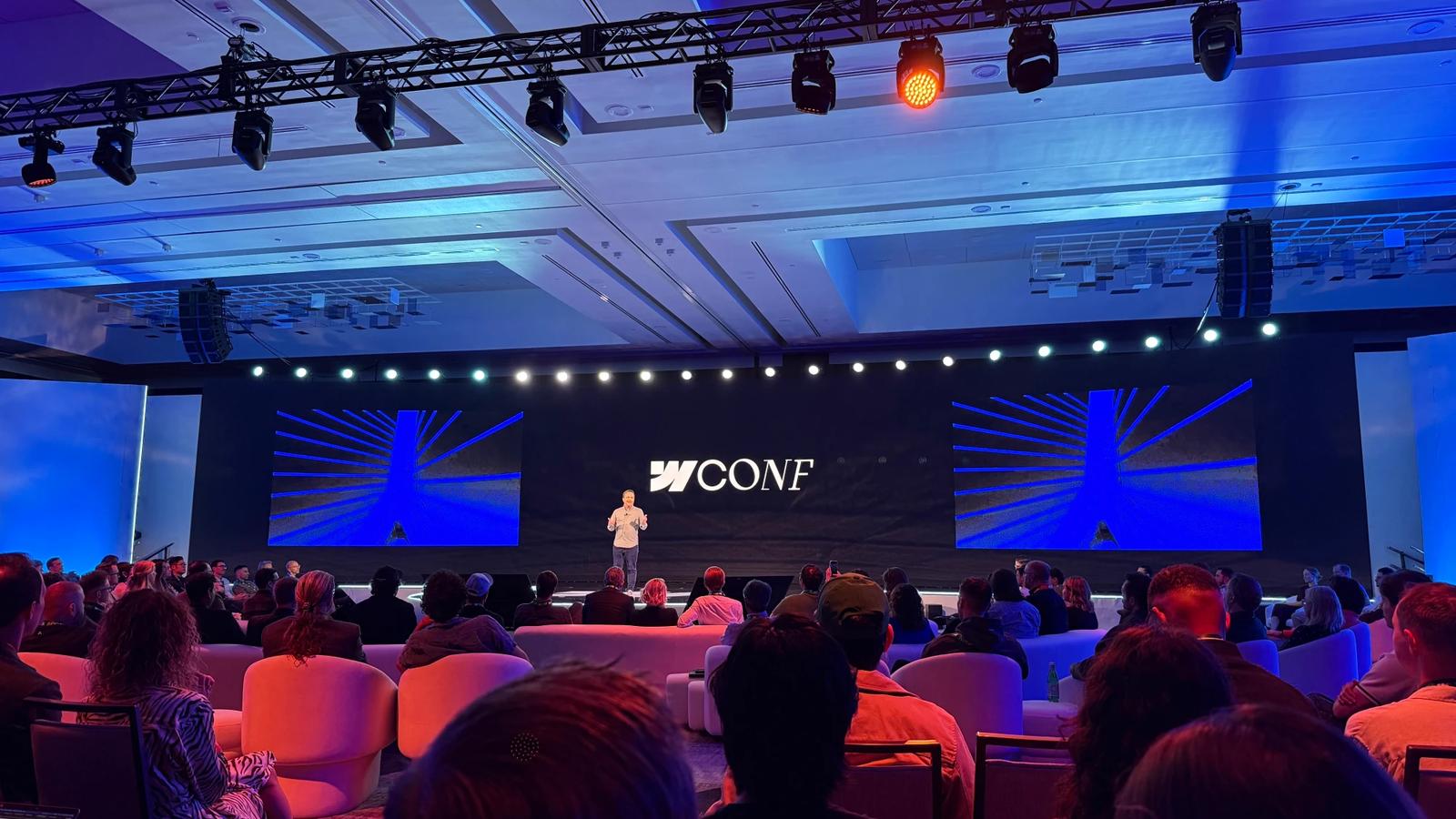
A month on from Webflow Conf 2026, the biggest announcements are easier to separate from the initial excitement. And the conversations we kept having after Boston turned out to be just as interesting as what happened on stage.
Three members of the Scaler team attended Webflow Conf 2026, each bringing a distinct perspective and set of priorities.
David Nathan, our CEO and Co-Founder (middle), was watching the bigger shift around Webflow itself: who the platform is building for now, how enterprise teams are using it, and what that means for agencies like ours.
Jesse Shauffer, our CTO and Co-Founder (right), wanted to get past the keynote language and understand what had actually changed technically. What was usable? What was still early? What might genuinely change the way his team builds?
Jack Boeger, our Chief Growth Officer (left), was more interested in what all of this could do for growth teams. He was watching search, Campaigns, AEO, and anything that could shorten the gap between spotting an opportunity and getting something useful in front of a customer.

Because the three of them returned with distinct viewpoints, debriefing on the conference proved far more engaging.
There were products that excited one of them and left another skeptical. There were announcements that sounded huge on stage but felt less immediate once you dug into them. And there were smaller updates, particularly around CMS, collaboration, and agent workflows, that may end up mattering more in day-to-day client work than some of the headline launches.
This article will talk about what caught our attention, assessing Webflow's trajectory, and identifying the updates that carry real significance for the organizations we partner with.
Webflow Conf 2026 Signaled a Broader Enterprise Ambition
David had been to Webflow Conf in 2022, and the difference was obvious to him before he started thinking about individual products.
The earlier conference felt, in his words, almost like a family reunion. It was heavily rooted in the community that had grown alongside Webflow: designers, developers, freelancers, agencies, and people who already knew each other from the ecosystem.
Boston in 2026 felt like a different stage of the company’s life. There were more enterprise teams, technology partners, marketers, developers, and cross-functional groups thinking about Webflow as part of a much larger digital operation.
Even before examining specific product announcements and keynote speakers, David recognized a fundamental shift in the conference's audience:
“It was like, wait a second, they don’t see themselves as a website platform anymore.”

This became one of the clearest themes to come out of the conference.
Webflow still cares about building websites. However, the announcements also showed how far Webflow is expanding beyond the website itself, into areas like campaigns, search, brand management, CMS operations, agent workflows, and the systems connecting them.
Jesse picked up on the same shift, but viewed it with a little more caution. Webflow appeared to be putting much more energy into marketers. That makes sense commercially, and he could see the opportunity in it, but he also came away feeling that the developer story wasn’t always as mature as the broader platform vision.
Jack saw the change from another angle. To him, the broader audience made sense because marketing teams already work this way. Paid, organic, content, design, development, and analytics are intertwined whether the software reflects that or not.
The rest of the conference showed how Webflow plans to bring more of those functions together within the same platform.
Source was the clearest example.
Source: An Ambitious Vision That Still Has Something to Prove

It was difficult to go to Webflow Conf 2026 and miss Source.
Webflow positioned it as a broader operating environment around modern web work: code, CMS, hosting, marketing tools, developers, marketers, and agents working closer together. You can see why Webflow is going there.
Websites rarely live in one neat system anymore. They sit across a mix of platforms, repositories, CMSs, analytics tools, marketing automation, advertising platforms, and internal workflows. The more complex the company, the more complicated that picture usually gets.
We’ve already seen some of that shift in the way AI-generated builds increasingly depend on the systems around the website to keep them maintainable.
David immediately saw the appeal of Webflow trying to make that environment easier to work with. Scaler has used Webflow for years. One of the reasons it became so important to us in the first place was that it made sophisticated web development more accessible without requiring every person touching the site to be a traditional developer.
If Source can eventually do something similar across a broader stack, there’s a real opportunity there.
Jesse’s first reaction was considerably more cautious.
“I think Source feels overhyped. For sure.”
On its own, the comment sounds more critical than Jesse’s overall view.
After attending the Source keynote and speaking directly with Webflow developers, he is eager to get hands-on access, recognizing how several of Scaler’s existing client builds could eventually integrate into Source.
His hesitation simply stems from a gap between the scale of the announcement and the current maturity of the product.
This perspective surfaced repeatedly throughout his interview. While he supports Webflow’s long-term trajectory and hopes the technology matures rapidly, he won't overhaul an established development workflow for a research-preview product based on a compelling demo alone.
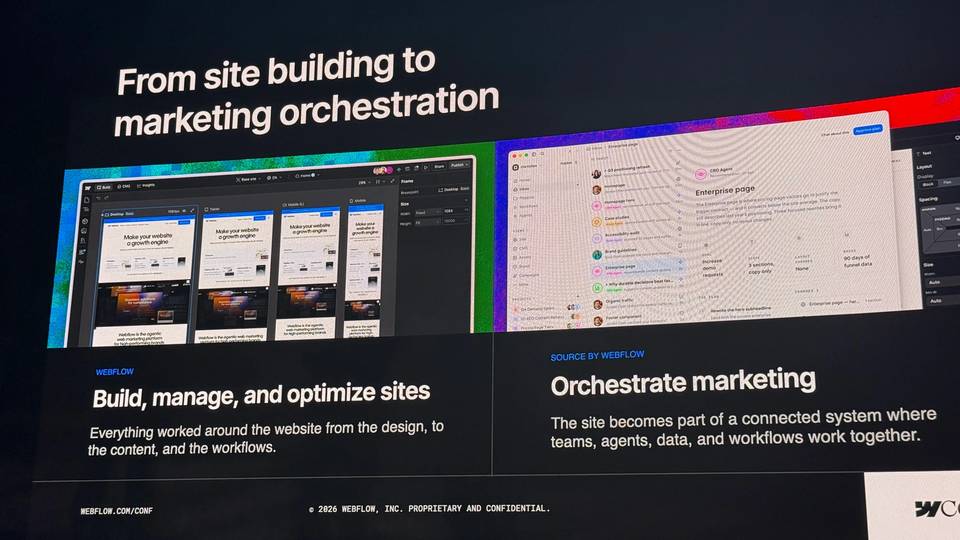
That’s probably the right level of caution for other teams too. A product like Source matters if it reduces the operational burden of a complicated stack without forcing you to give up the flexibility you built that stack for in the first place.
Jack was particularly interested in that point. He is not someone who naturally wants one platform to own every part of the workflow. His preference is closer to “use the best tool for the job and make the tools work together”.
“What glues them all together is just being experts in your field and just having the judgment to know what’s working and what’s not.”
Jack is less interested in consolidation itself than in whether Source can make a composable stack simpler to operate.
If Source can simplify a composable stack while preserving the strengths of specialist tools, that’s compelling. If it simply replaces those tools with less capable alternatives inside a single platform, the value is much harder to see.
For now, the ambition is clear; the question is how well the product delivers on it.
Campaigns: Tackling the Time-to-Market Problem
Campaigns resonated with Jack straight away because it addressed a problem he already sees in practice.
“This was the part of the keynote where I really perked up.”
There’s a simple reason for that. Turning a good marketing opportunity into a live campaign can take time, even when everyone is aligned on the direction.
Someone identifies a gap. Then the product team needs to weigh in. Messaging gets developed. A landing page goes into a queue. Creative has to be made. Tracking needs setting up. Someone has to approve it all.
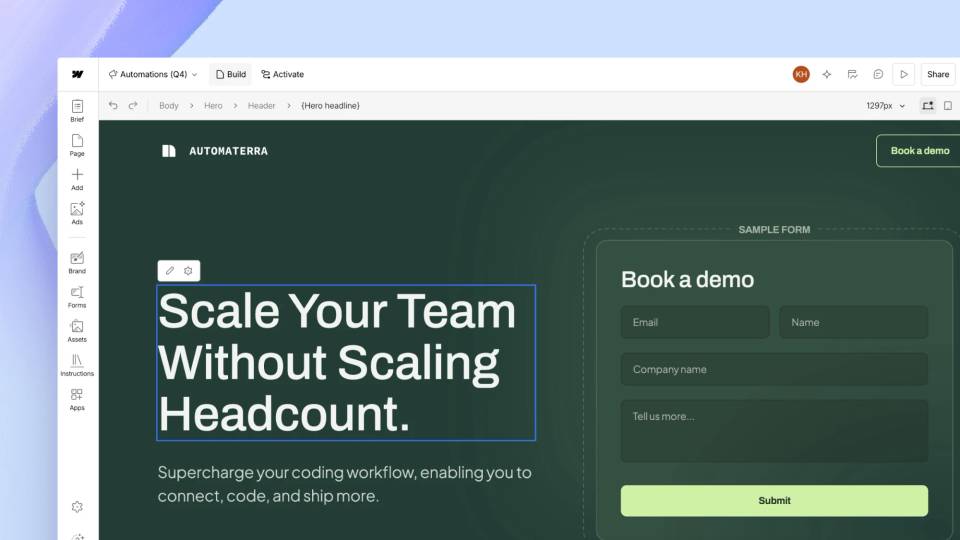
Jack has watched that process stretch to four, sometimes six, weeks. For a growth team, that’s a long time. So when Webflow presented Campaigns as a way to bring the brief, landing pages, variants, creative, and execution closer together, the benefit was obvious.
Giving marketers more control over campaign creation and launch could reduce a lot of friction, which was what made the keynote pitch appealing. The breakout session, however, raised a few more questions for Jack.
The more Jack thought about the kinds of clients Scaler works with, the more he questioned whether a fast, AI-generated campaign workflow would translate cleanly into complex B2B buying journeys.
AI can generate a page, but the real challenge is making sure that page reflects where someone is in the buying journey. A top-of-funnel visitor needs a different experience from someone who already understands the product and is comparing vendors.
What changes throughout the buying journey:
- The proof someone needs
- The trust signals they look for
- The most appropriate conversion point
- The level of product information they’re ready for
Sometimes the product manager or technical team needs to be involved before the message is even ready to write.
“I like the whole idea of the speed, but I don’t know if this is… I think there’s other ways to get that kind of speed.”

From left to right: Oana Manolache, CEO & Founder of Sequel.io; Heather Freeland, Chief Brand Officer at LinkedIn; Whitney Magnuson, VP, Head of Brand & Media at Zoom; Dan Slagen, CMO and Chief AI Transformation Officer at Zapier; and Dave Steer, CMO at Webflow.
Jack was specific on what he wanted the product to achieve. He likes the idea of shortening the four-to-six-week stretch between spotting an opportunity and getting a campaign live. What he doesn’t want to lose in the process is the strategic thinking that happens inside that window.
For the kinds of B2B teams Scaler works with, the value will depend on whether Campaigns can remove production friction without flattening the thinking around intent, product accuracy, and the buying journey.
Assets: Scaling Creative Without Diluting the Brand
Assets connected directly to something Jesse has been experimenting with in his own AI-assisted design and development work: without a strong design system, the output quickly becomes inconsistent.
“If you don’t have the design system in place, it just comes out like slop.”

You can get a strong result from AI without much structure. The harder part is getting the next five to feel like they belong to the same brand. Without a clear design system, small inconsistencies start to creep in: spacing shifts, hierarchy changes, components drift. We’ve seen the same tension in our own experiments with automated creative production, generating the asset is often the easy part; keeping the system around it consistent is harder.
That’s why Webflow’s Assets direction makes sense in the context of what Jesse is seeing. Webflow is trying to give the system enough brand context to keep that output coherent.
Jesse’s view was clear:
“Brand is actually more important than ever.”
That gets more important as the size of the organization grows.
Brands already struggle with consistency across teams, agencies, countries, campaigns, and channels. Now add generative tools that can multiply output dramatically.
If the brand rules aren’t clear, faster production can quickly turn into inconsistent output. That’s the part of Assets we’ll be watching most closely. Not simply how much it can generate, but how well it helps teams keep that work aligned with the brand system already in place.
AEO: Expanding AI Discovery Without Abandoning SEO
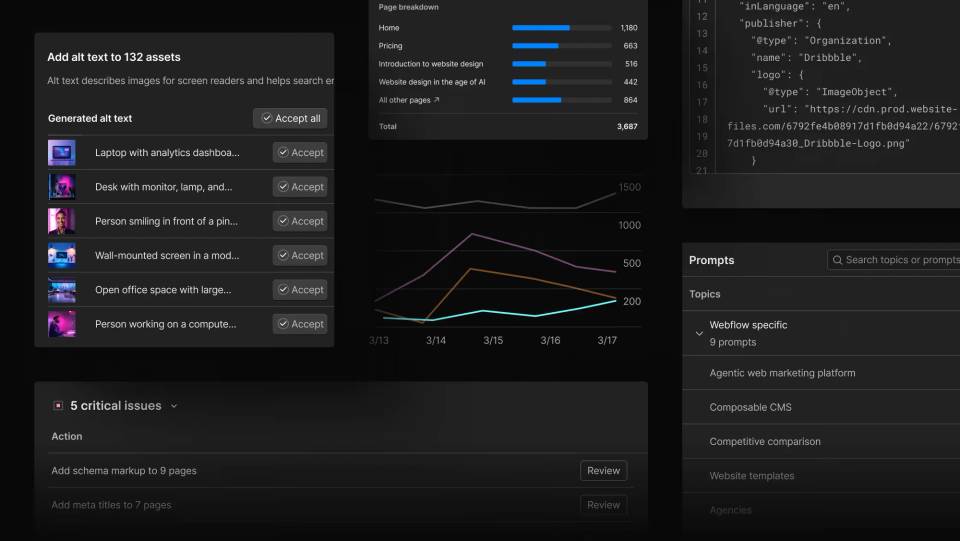
If Campaigns interested Jack because of speed, AEO interested him because it is already changing how brands get discovered.
Webflow’s tools are designed to show where a brand is appearing across major AI platforms, where competitors are being cited instead, and where there may be opportunities to create new content. It’s closely connected to work Jack is already doing, but he doesn’t see AEO as a replacement for SEO.
Quite the opposite.
“You have to have that traditional SEO foundation or you’re not gonna do well in AEO.”
That’s an important point because the current AEO conversation can make it sound like companies need to throw out the old search playbook and start again.
Jack doesn’t see it that way:
- Good site structure still matters
- Useful content still matters
- Authority still matters
- Understanding what the customer is asking still matters
What changes is where the answer can show up. That’s where he made one of the more interesting observations from any of the interviews:
“Less people are visiting the website. But the website is going to be more important than ever.”
That sounds contradictory until you look at what’s happening.
Someone can now ask a question inside an AI product, get an answer about your company, and never open your site. The website still helped form that answer, it just didn’t necessarily receive the visit.
Jack thinks that puts more weight on what he calls information design:
“It is about the information design more than the visual design. The visual design is for people.”
He isn’t arguing that visual design is becoming irrelevant, after all, he spent years in design himself.
Jack’s point is that visual design and information structure now serve different audiences. People experience the site visually, while search engines and LLMs rely on the underlying information to understand what a company does and how its content fits together.
For large organizations managing thousands of pages across different markets and business units, information architecture becomes increasingly important.
In that sense, AEO is less about finding a shortcut into AI results and more about making sure the website is clear, well organised, and useful enough to be understood wherever its information appears.
MCP 2.1, Agent Presence, and Releases: Making Agentic Workflows Operational
MCP 2.1
Jesse was more cautious about Source, but MCP felt different because he was already using it in practice. He’d seen a meaningful improvement with version 2.0 before the conference, and 2.1 looked like a continuation of that progress. This wasn’t something he was waiting to validate after a keynote as it was already part of his day-to-day workflow.
The broader implication for Jesse wasn’t that developers suddenly become unnecessary.
“Anyone could do anyone’s job with it, but it’s still really key to have specialties.”
He came back to language as a very simple example. A developer naturally describes a website differently from a marketer because they understand the structures underneath it.
That changes what they ask the agent to do and whether they know the result is actually any good.
Agent Presence
Agent Presence, for Jesse, solves a very mundane coordination problem.
If somebody on Jesse’s team is working on a particular part of a Webflow project, he can see it. If an agent starts working there too, he wants the same visibility.
That may not be the kind of feature that gets the biggest applause in a keynote, but it’s the type of thing that starts to matter when agents become normal participants in a production environment rather than separate tools people occasionally open.
Releases
While releases didn’t come up directly in the interviews, it fits the same shift Webflow is taking. If agents are going to become part of everyday website work, teams will need a clear way to review changes, control access, and move work into production safely.
Builder Keynote: Practical Improvements for Day-to-Day Web Operations

Not everything Webflow presented became a major topic in our interviews. That doesn’t mean those updates were irrelevant. The Builder Keynote, in particular, gave a better sense of what Webflow is trying to improve for the people actually working inside the platform day to day.
Visual editing for AI-generated code components
AI-generated components become much more useful when teams can continue editing them visually, rather than relying on prompts for every change. It keeps the speed of generation without giving up control.
Components in the CMS
Bringing reusable components into CMS rich text gives content teams more flexibility without opening the door to completely inconsistent layouts. For larger teams, that balance could be especially useful.
Breakpoint canvas
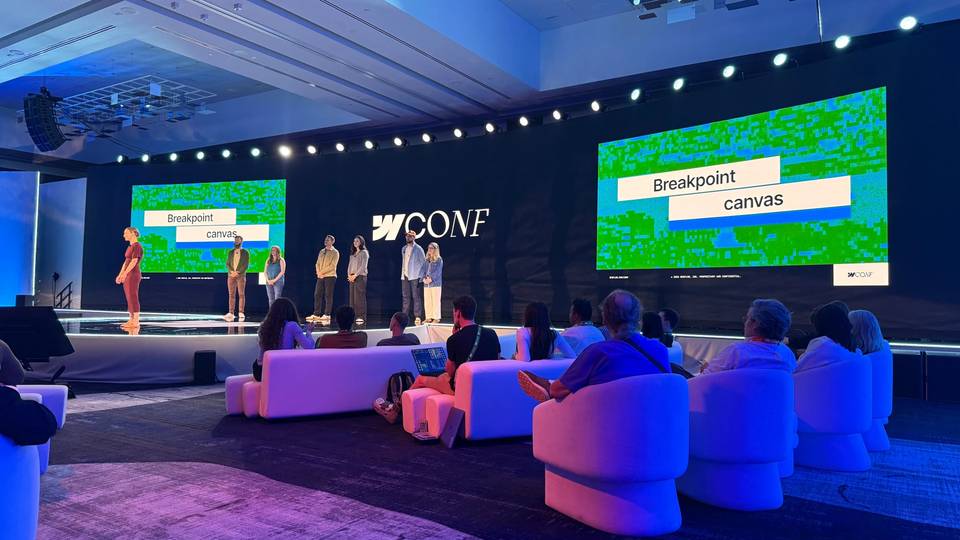
Seeing desktop, tablet, and mobile states together makes responsive changes easier to understand and review. It’s a smaller update, but one that could make day-to-day site work noticeably smoother.
Agentic Translation
The challenge with localization is rarely the first translation alone. It’s keeping multiple markets up to date as the main site changes. Automating more of that process, with review still in place, could take a lot of manual work off global teams.
Next-Generation CMS: A More Immediate Opportunity for Scaler
For all the attention Source received, when Jesse started talking about what might actually affect how Scaler builds over the next year, he kept coming back to the CMS.
Jesse likes Webflow’s editing experience. Clients understand it and it feels clean.
But Scaler sometimes needs more flexibility than Webflow’s traditional CMS structure has allowed, particularly on more complex builds.
That’s why we also work with headless CMS platforms. They give us more structural freedom, but that freedom comes with more configuration and more decisions about the editing experience.
Jesse is interested in what happens if Webflow can close that gap:
- More flexible content structures.
- Fewer workarounds.
- Less need to split related content into separate CMS setups.
- A clean interface for the client without sacrificing as much power underneath.
“If we can get that back, have the power of Sanity, I think that would be huge for us.”
Webflow’s next-generation CMS had already begun rolling out before the conference, so this wasn’t a brand-new Webflow Conf announcement. What the event did was give Jesse more context for where the CMS appears to be heading and how it might eventually fit into Scaler’s own stack.
A website still has to be easy to manage long after it launches, and that can matter just as much as how sophisticated the build is. If the marketing team finds the CMS difficult to use, the setup starts to lose its value.
For Jesse, the question wasn’t only what developers can build, but what the experience is like for the team that has to run the site afterwards.
David’s Takeaway: Webflow Conf Validated Scaler’s Direction

For David, the conference was less about one standout announcement and more about the direction Webflow seems to be heading in. He described the trip as “a whole lot of validation.”
Scaler had already been moving beyond website delivery because that’s where client work was taking us. A website rarely sits on its own. It connects to positioning, search, content, paid media, brand, and the day-to-day reality of how the client manages everything after launch. Seeing Webflow move further into those areas felt familiar.
The enterprise side of the conference stood out to David too. Being around larger companies made that opportunity feel more real, but not in the sense that Scaler suddenly needs to chase scale for the sake of it. Bigger organizations simply come with more moving parts, more stakeholders, more systems, more approvals, more teams and Scaler has already been building toward that kind of work.
“The goal was not to just take on whatever we could, whether we knew we could deliver it in an excellent way or not.”
That doesn’t mean Scaler needs to offer every adjacent service because the software makes it possible. The client problem still comes first.
Jack’s Takeaway: Speed Matters, but Strategy Still Differentiates

Jack kept coming back to the same idea throughout the conversation. He liked the speed Campaigns could bring, he could see why AEO matters as discovery changes, and he was interested in Source because website content is starting to live beyond the website itself. But for him, the value of any of those tools depends on what teams actually do with them.
“I think speed is a competitive advantage, but if everyone has the same advantage…”
Once everyone can move faster, speed on its own doesn’t really set you apart. The difference comes from understanding the audience, reading the data properly, making better decisions, and creating something worth paying attention to.
“It’s creativity that’s gonna stand out and set you apart.”
That’s especially relevant to Campaigns. If building and launching a landing page becomes easier for everyone, the real advantage shifts back to the thinking behind it, what you say, who it’s for, and whether it actually resonates.
Jesse’s Takeaway: Stronger Momentum, With Technical Ground Still to Cover

Jesse came away encouraged by the direction Webflow is heading, even if some parts of the conference stood out to him more than others. Source caught his attention, but the updates he was most excited about were the ones he could already picture fitting into Scaler’s work, particularly MCP, Agent Presence, and the future of the CMS.
“I’ve been having great luck with 2.0 and now 2.1 is even stronger.”
He also noticed a renewed energy around Webflow’s engineering team, which gave him more confidence in where the platform is going.
“There was an energy with the engineers there that a lot of people haven’t seen in years.”
His interest comes from knowing the platform well and having seen how valuable it has been to Scaler over the years.
More than anything, Jesse left wanting to see that momentum continue. The wider development landscape is moving quickly, and he sees a real opportunity for Webflow to build on what it showed at the conference and keep evolving alongside it.
How AI Connects Webflow’s 2026 Product Direction
It would be impossible to write an honest reaction to Webflow Conf 2026 without talking about AI. It. Was. Everywhere.
- Source
- Campaigns
- Assets
- AEO
- MCP
- Agent Presence
- Translation
- The way Webflow talked about builders now included agents alongside people.
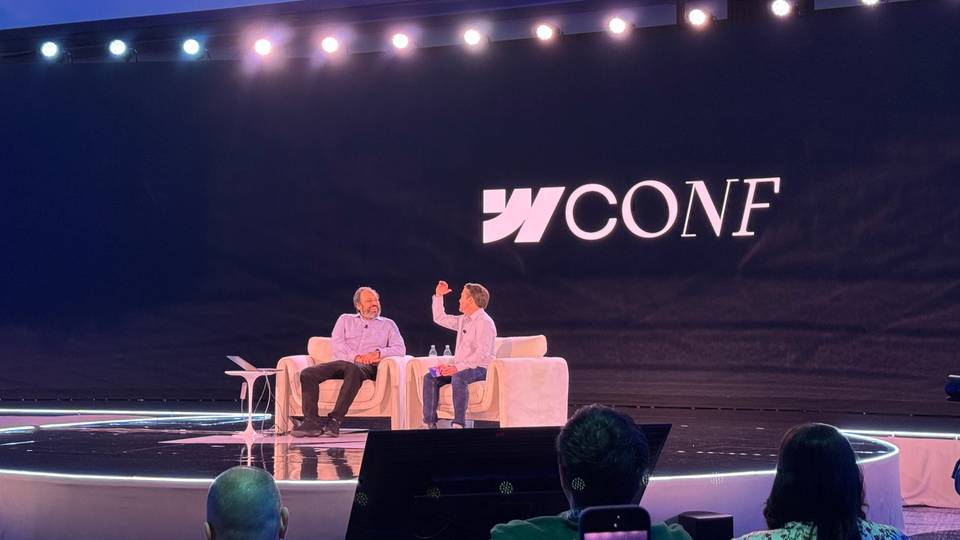
Fireside Chat with Ethan Mollick at Webflow Conf 2026 explored how the shift from using AI to managing AI agents is changing the way teams work.
The question brought up was what happened once AI made more work possible and what teams would do with the extra capability. It’s a question we’ve been thinking about beyond Webflow too, particularly as AI changes what smaller and larger teams are capable of producing.
David saw the agency question immediately.
“Just because you can build a website using AI doesn’t mean you can build an effective website.”
Jesse saw it in technical output. Give an agent better context and a better operator and you get better work.
“If you know the foundational structures underneath all of that stuff, when you’re talking to AI, you just get such stronger outputs.”
Jack saw it in marketing. When speed is universal, strategic campaign selection is what sets you apart.
“We have to be very careful about the intent and very, very specific.”
Three Perspectives on the Website of the Future
At the end of each interview, we asked David, Jesse, and Jack to finish the same sentence: The website of the future will…
David Nathan, CEO & Co-Founder: More Personalized
“The website of the future will feel like much more of a personalized experience built for each individual user.”
David sees the website becoming more responsive to the person using it rather than presenting everybody with the same route through the business.
Jesse Shauffer, CTO & Co-Founder: More Experiential
“The website of the future will be very experiential, I guess.”
Jesse expects richer, more immersive, increasingly application-like experiences as development becomes easier. He also hopes that doesn’t mean the web becomes a collection of chat windows.
“People still like browsing... they don’t always just want to be in a text box.”
Jack Boeger, Chief Growth Officer: More Distributed
Jack took the question somewhere else.
“The future of the website is beyond website.”
He sees the website becoming the structured digital representation of the company. Information starts there, but it doesn’t stay there. It gets surfaced through search, AI, ads, sales, PR, partners, and other channels.
“The website is your electronic representation of your brand.”
Which means the structure underneath it has to stay coherent.
“It can’t be a sprawling mess.”
What Scaler Took Away from Webflow Conf 2026
We came away from Webflow Conf with a clearer sense of where the platform is heading, but not with the feeling that every announcement needs an immediate response. Some ideas feel ready to influence the way we work now; others are more interesting as signals of where Webflow is going next.
What mattered most was how differently David, Jack, and Jesse reacted to the same event. David saw validation in the broader direction of the platform. Jack focused on what the changes could mean for growth and discovery. Jesse looked at what would actually hold up in a technical workflow. Those perspectives didn’t always lead to the same conclusion, and that was probably the point.
Websites sit at the intersection of a lot of competing needs. They have to support marketing, development, content, growth, brand, and the people who are left running the thing once the launch is over. The useful question is rarely whether a new tool is exciting. It’s whether it makes that system work better.
That’s the lens we came home with. And it’s the one we’ll keep using as Webflow’s next wave of products moves from conference stage to real-world use.